
Probate Belongs to Smith County Chancery Court
Smith County has no separate Probate Court. Mississippi assigns probate to Chancery Court, the court that hears matters of equity. The official county courts page states that Chancery Court handles estates of decedents, with or without a Last Will and Testament, and all issues involving minors. The same court also hears divorce, child custody, adoptions, land disputes, and mental health commitments.
That single fact shapes every probate search here. There is no probate judge to call and no probate clerk separate from the rest of the county. Two chancellors serve the district. The Chancery Clerk creates and maintains a file for each Chancery Court suit, keeps the minutes, issues process, and accounts for filing fees. Estate cases, will contests, and guardianship petitions all land in that office.
Because probate sits inside Chancery Court, the same records desk that handles divorce and land deeds also handles wills and estates. People who expect a stand-alone probate division often lose time. Send the request straight to the Chancery Clerk.
Probate Terms Defined
Probate filings carry words that rarely show up in daily speech. A short glossary helps a reader follow an estate file from start to finish. These terms appear across Smith County estate petitions, orders, and decrees.
- Testator
- The person who made the will. A testator signs the document that names who should inherit and who should manage the estate.
- Executor
- The person named in the will to carry out its terms. The court grants letters testamentary to confirm that authority.
- Intestate
- Dying without a valid will. The court then opens an administration and follows state law to decide heirs.
- Administrator
- The person the court appoints to settle an estate when there is no will or no named executor able to serve.
- Guardianship
- A Chancery case that gives an adult legal authority over a minor's person, property, or both.
- Conservatorship
- A Chancery case that places an adult who cannot manage personal or financial affairs under a conservator's care.
What Smith County Probate Covers
Probate is broader than reading a will. Smith County Chancery Court opens estates whether or not the person left written instructions. It also protects people who cannot protect themselves, including children and adults with impaired capacity.
The main categories that route to Chancery Court are clear from county and state sources. Each carries its own petition, its own proof, and its own set of orders.
- Estates with a will, where the court admits the will and appoints an executor.
- Estates without a will, where the court appoints an administrator and applies the law of descent.
- Guardianships of minors, covering a child's person, property, or a minor's settlement.
- Conservatorships for adults who cannot manage their own affairs.
- Will contests and heirship disputes, which a chancellor decides.
- Land and estate overlap, where deeds, liens, and title questions touch a decedent's property.
Many of these files mix public and protected material. An ordinary estate is largely open. A guardianship or a minor's settlement carries sensitive detail and may be closed in part.
How Smith County Probate Works
An estate moves through a set order of steps. The path is similar whether a will exists or not, though the documents differ. The Chancery Clerk and the chancellor each play a role at every stage.
- Decide which path fits. The family weighs a full estate, a will probate, an administration, a guardianship, a conservatorship, or a small-estate affidavit.
- File the petition or affidavit with the Chancery Clerk when Smith County is the proper venue. The clerk opens a cause and creates the suit file.
- Pay the filing fee set by the Chancery Clerk at the time of filing. The county does not post a fixed probate filing amount.
- The chancellor reviews each petition and issues orders. The court may require a bond, creditor notice, an inventory, an accounting, or a hearing.
- Request copies of recorded orders, estate papers, and related land records through the Chancery Clerk once the file is built.
Public portions of the file open to anyone who asks. Minor, guardianship, conservatorship, sealed, and other sensitive records may stay restricted. The clerk decides what may be released.
Smith County Chancery Clerk Contact
Cindy Austin is the Smith County Chancery Clerk. Her office holds the estate files, wills filed in estates, guardianship and conservatorship papers, Chancery orders, and the land records tied to a decedent's property. The county notes that Chancery Clerk records and Chancery Court sessions are now in the new Chancery Building across from the Smith County Courthouse, so probate visitors should head there rather than the older courthouse.
Smith County Chancery Clerk
Cindy Austin, Chancery Clerk
Chancery Building
P.O. Box 39, 201 Courthouse Square
Raleigh, MS 39153
601-782-9811
Fax: 601-782-4690
Two chancellors hear Smith County cases. The Honorable David Shoemake serves Post 1 from Collins, and the Honorable Gerald Martin serves Post 2 from Raleigh. Estate filings still go through the Chancery Clerk, who schedules courtroom time and maintains the dockets. The clerk's office also feeds the related Smith County Chancery Clerk duties of land records and Board minutes.
How to Search Smith County Probate Records
Smith County does not run its own online probate database. The statewide route is Mississippi Electronic Courts, reached through the Public Access portal. PAMEC may hold Chancery Court probate dockets and filings where remote access is allowed, but guardianship, conservatorship, minor settlement, and other sensitive cases can be blocked from remote view. Treat the system as registration based and fee based, not a free open search.
For a closer look at how the county frames its records counter, the official land records FAQ category at Smith County's land records FAQ lays out inspection hours and copy rules at the Chancery Clerk's office.
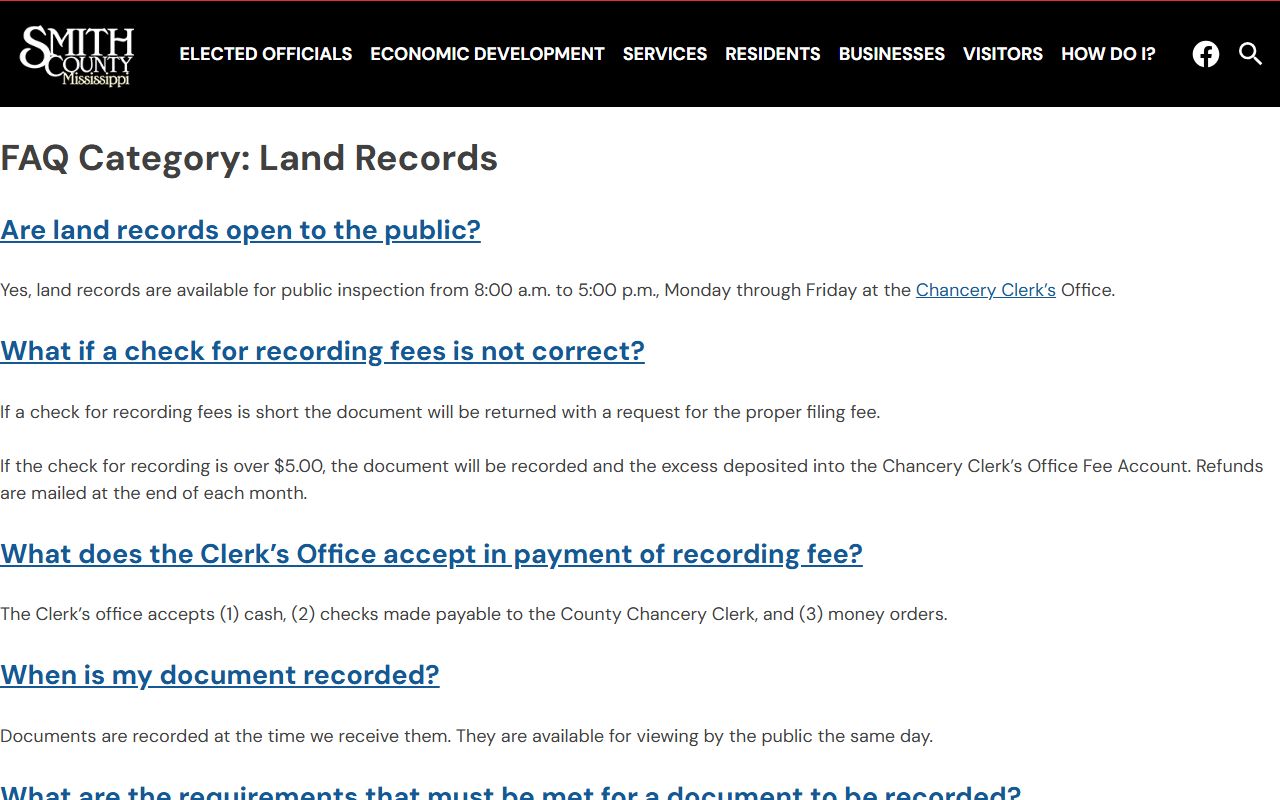
That FAQ confirms land records are open for public inspection from 8:00 a.m. to 5:00 p.m., Monday through Friday, which is the same office that pulls estate files for visitors. The access channels for probate run in a clear order.
- Online through PAMEC for Chancery dockets where remote access is permitted.
- In person at the Chancery Building, 201 Courthouse Square, during posted records hours.
- By phone to the Chancery Clerk at 601-782-9811 to confirm a file or a cause number.
- By mail with a written request that identifies the estate, cause, book, or page.
Note: the public search screen inside PAMEC requires an account, so the live case fields cannot be viewed without registering first.
Smith County Probate Fees and Copy Costs
The Chancery Clerk sets the filing fee for a probate petition at the counter, and Smith County does not post a fixed amount for opening an estate. Copy costs, by contrast, are posted in the county FAQ. The figures below apply to records the Chancery Clerk releases.
| Item | Amount |
|---|---|
| Probate or estate filing fee | Set by the Chancery Clerk; amount not posted |
| Copy made by the public, per page | $0.25 |
| Copy made by staff, per page | $0.50 |
| Certified copy | Additional certification fee; amount not posted |
| Mailed copy request | Copy cost plus stamped self-addressed envelope |
A mailed request must reasonably identify the document. Include a check or money order made payable to the Smith County Chancery Clerk, and add a stamped self-addressed envelope for the return. The official copy-fee FAQ at Smith County's copy request FAQ spells out the public and staff rates and the certification note.
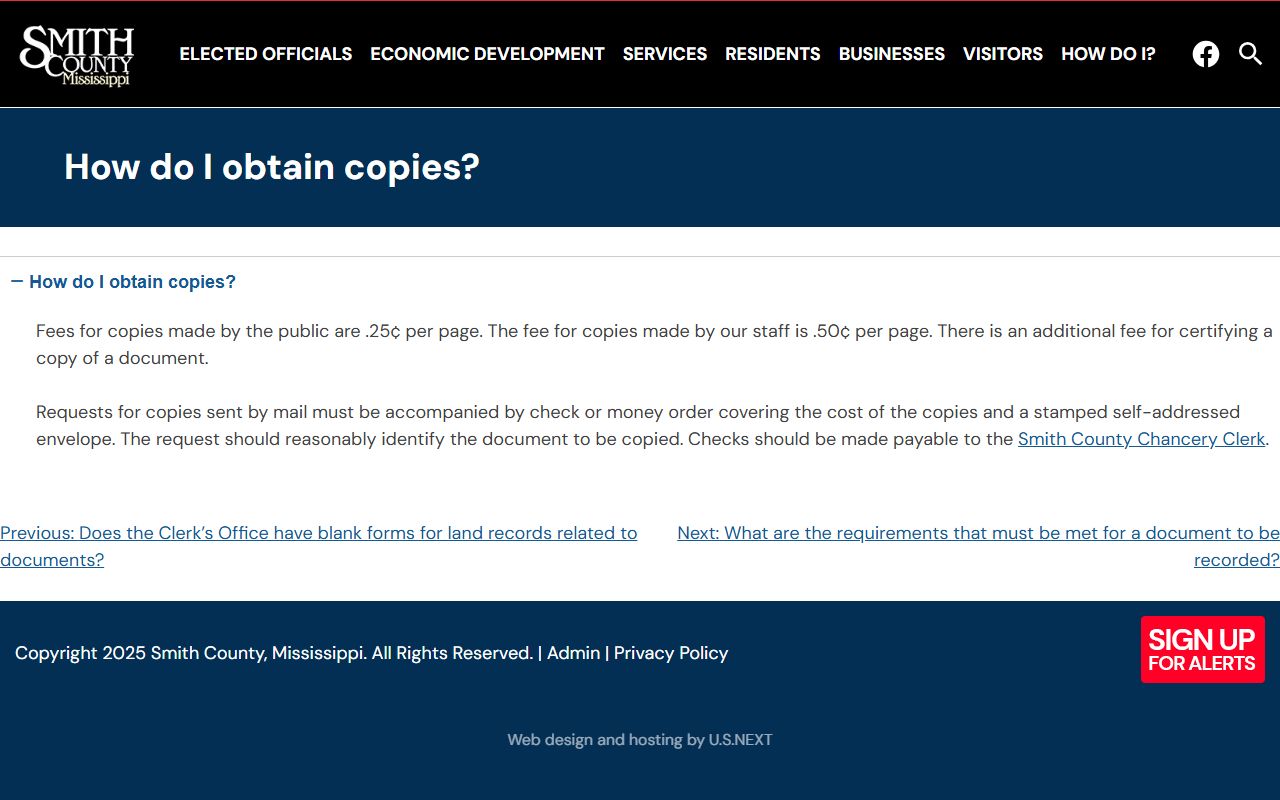
That copy page is the practical guide for anyone who cannot visit in person. It tells a requester exactly what to enclose so the office can mail back certified or plain copies of estate papers.
What Smith County Estate Files Contain
An estate file grows as a case moves forward. The contents depend on whether the person left a will. Both kinds of estate share many of the same papers.
An estate opened with a will usually holds a petition or application, the original will, proof of the will, an order admitting it, letters testamentary, an oath, a bond if required, an inventory, a creditor notice, an accounting, receipts, and a final decree. An estate without a will holds a petition for administration, heirship information, letters of administration, a bond, an inventory, a creditor notice, an accounting, and distribution orders.
Likely visible fields in a Chancery probate cause include the cause number, the style of the case, the petitioner, the respondent, the case type, the filing date, the chancellor, the orders, pleadings, service entries, hearing settings, the decree, inventory and accounting entries, and any minor data that the court redacts. These estate records sit alongside the wider body of Smith County court records the clerks maintain.
Small Estate Affidavit Caution
Mississippi offers a shortcut for some small estates. A successor affidavit can collect certain personal property or debts of a person who has died, without a full estate being opened, once statutory conditions are met. The rule lives in Miss. Code Ann. Section 91-7-322.
Verify before you rely on it. Online summaries disagree on the dollar limit and the waiting period for the small-estate affidavit. Confirm the current threshold and conditions in the current Mississippi Code text or with the Chancery Clerk before acting. Do not treat a figure from an unofficial summary as final.
The affidavit process is narrow. It does not transfer real estate, and it does not replace probate when a contest or a complex estate is involved. When in doubt, the Chancery Clerk can point a person toward the correct filing.
Probate Versus State Vital Records
People often confuse court estate files with state vital records. They come from different agencies. The Mississippi State Department of Health handles birth, death, and marriage certificates, and lets the public order some of them online or by phone. Divorce decrees, by contrast, come from the Chancery Clerk, not the health department.
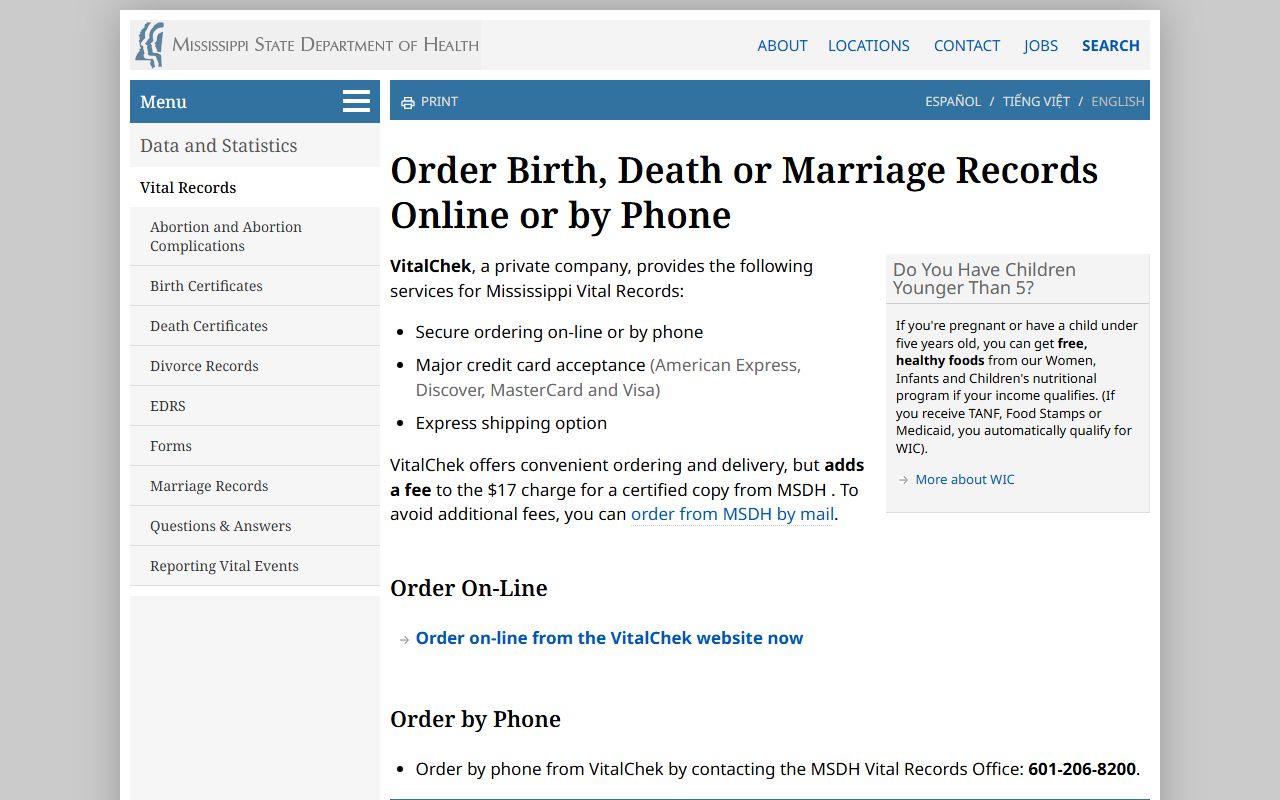
The MSDH online ordering page above shows how vital records move through a state vendor, a route that does not apply to estate or guardianship files. Probate papers stay with the Smith County Chancery Clerk. A reader who needs both a death certificate and an estate file will deal with two separate offices, and divorce records overlap with the Smith County marriage and divorce records the Chancery Clerk also keeps.
Restricted Smith County Probate Records
Not every probate paper is open to the public. Mississippi law and court practice close several categories. The most common restrictions touch the people the court is meant to protect.
Guardianship and minor records, conservatorship files, minor settlement documents, and any sealed estate matter may be withheld or released only in part. Adoption files, which Chancery Court also handles, are sensitive and generally restricted. Mental health and substance-abuse commitments, another Chancery jurisdiction, are treated as confidential unless the clerk states otherwise. Remote access through PAMEC can exclude these categories entirely.
The Chancery Clerk applies these limits at the point of release. A request for a public estate file usually succeeds. A request that touches a child, a protected adult, or a sealed order may be reduced or refused. When access is denied, the office can explain which rule applies and whether a court order would be needed to view more.