
How to Search Smith County Court Records
Smith County has no county-built case portal. The statewide online route is Mississippi Electronic Courts, known as MEC, with public access through the Public Access Mississippi Electronic Courts system, or PAMEC. MEC is the state filing and case-management system for Mississippi courts. Search snippets from the Mississippi Judiciary MEC directory list both Smith County Circuit Court and Smith County Chancery Court. Public users register, pay an annual fee, and then view documents for a per-page charge. The fee is about $10 a year, with documents commonly 20 cents per page.
The Mississippi Judiciary describes the public side of the program in plain terms. The MEC general information page explains that the system is an internet-based filing and case-management tool that provides electronic docket and document access.
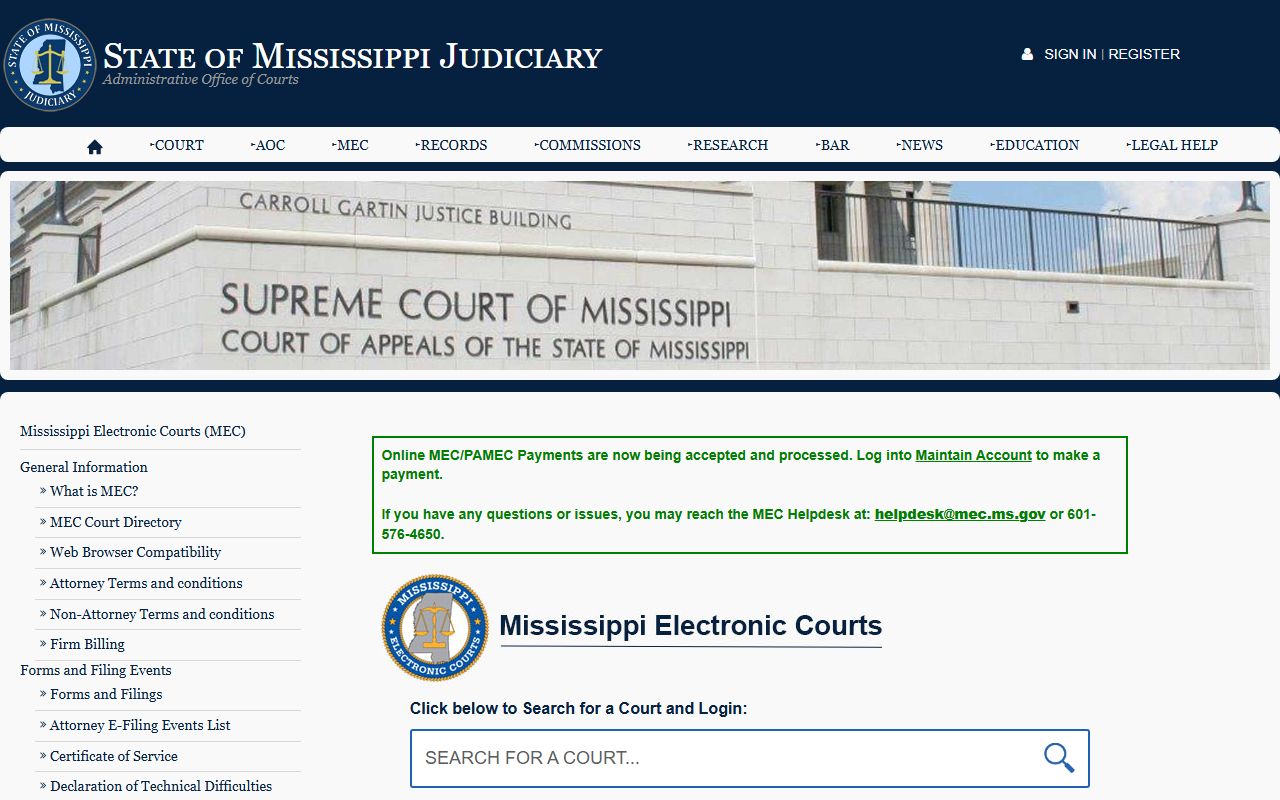
The landing screen routes registered users into the court directory and helpdesk links. A browser may show a security check before the page loads, which is normal for the state site.
Before starting, decide which court holds the case. Know the party name or case number if you have it. Have a card ready, since remote document access carries fees. Then work through these steps.
- Identify the case type. Felonies, indictments, major civil suits, and appeals from lower courts go to Circuit Court. Divorce, custody, adoption, estates, guardianship, conservatorship, and land-title matters go to Chancery Court. Traffic citations, small civil cases, and county misdemeanor charges outside cities go to Justice Court. City ordinance and city traffic cases may sit with a municipal court.
- Try PAMEC for remote Circuit and Chancery files. Open the Mississippi Electronic Courts public registration site, register if needed, and use the case-search tools after login. The public search screen is not visible without an account.
- If PAMEC blocks or excludes the record, call the clerk. Circuit and County Court files route to the Circuit Clerk. Chancery, probate, divorce, and land files route to the Chancery Clerk.
- For land records, visit the Chancery Clerk's Office during posted inspection hours. For copies, write a request that clearly names the document, and add the copy payment and a stamped self-addressed envelope if mailing.
- For a Justice Court traffic, criminal, or small civil case, call the Justice Court Clerk. The county directs people to Justice Court to set a hearing date on a citation or charge.
- For certified copies, ask the clerk for the certification fee and the way to submit payment. The county posts per-page copy costs but not every certification amount.
Smith County Court Records Search Fields
PAMEC is a registered-access system, not a free search box. The public side asks for an account before it shows any Smith County case. The PAMEC registration page is the entry point for that account. Registration comes first, then court selection, then case or party search.
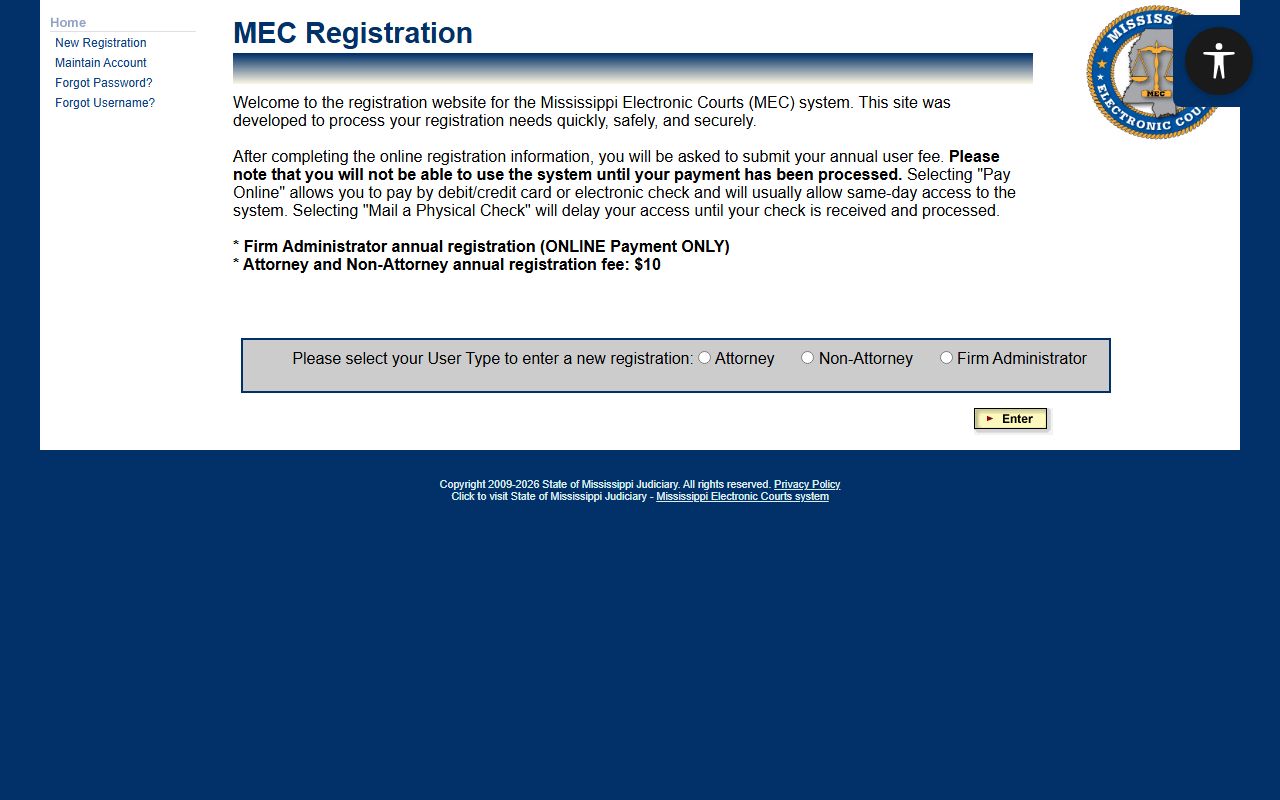
The registration form sets up the login that unlocks remote document viewing. Once the account is active, a court dropdown lets a user pick Smith County Circuit or Chancery Court. The fields below reflect what the public registration and search level expose.
| Field Label | Type | Required | Notes / Format |
|---|---|---|---|
| Account login / registration | Web account | Yes | Public access requires account registration before any case or document opens. |
| Court selection | Dropdown | Yes after login | Smith County Chancery Court and Smith County Circuit Court appear in the MEC directory. |
| Case number | Text | Optional | Standard search path; exact format is not visible without an account. |
| Party name | Text | Optional | Search by last name or business name. |
| Attorney | Text | Optional | Attorney search is reported by the system; the post-login screen was not inspected. |
| Document view / download | Paid link | Optional | Per-page fees apply; sealed or restricted cases are not available remotely. |
Use of the system is governed by posted terms. The PAMEC terms and conditions page sets out the rules for electronic access to case information in Mississippi state courts.
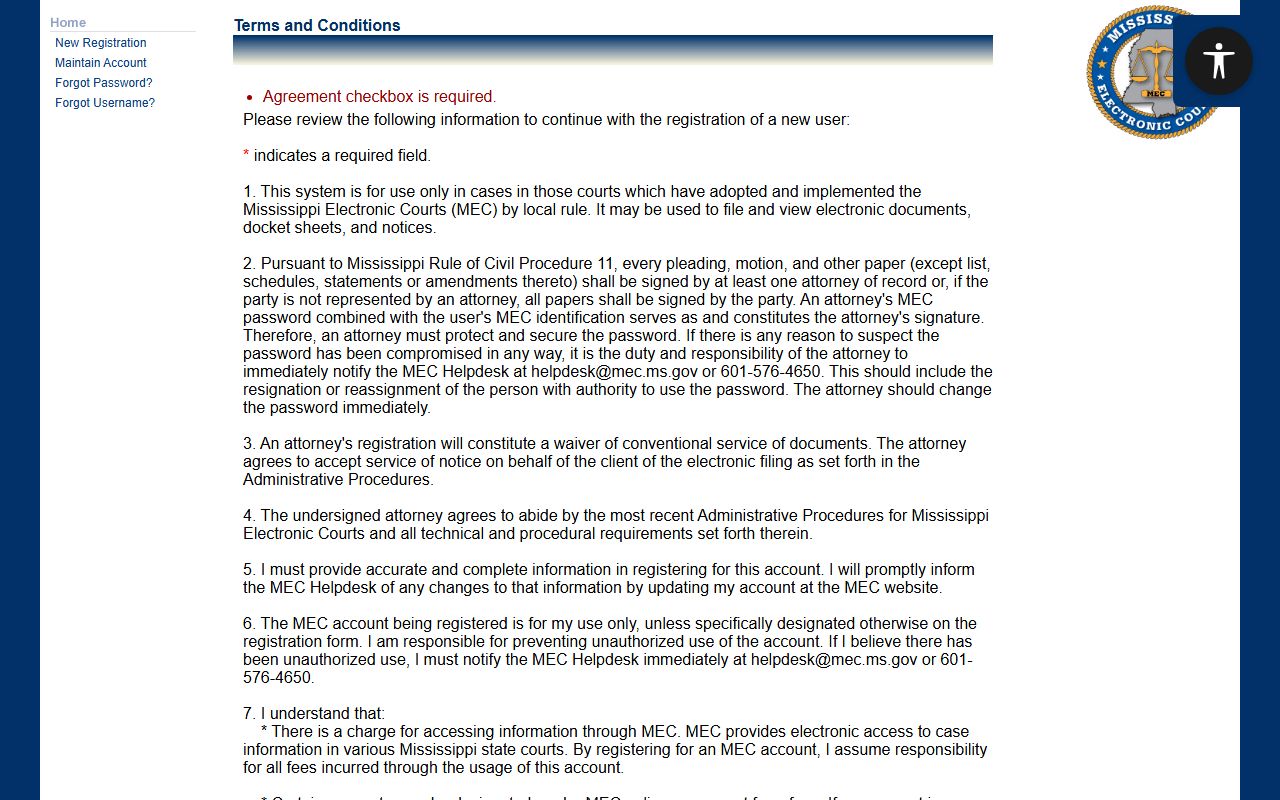
Reading the terms before paying matters, since the agreement covers proper use, fees, and limits on restricted files. A registered account is needed to reach an actual Smith County docket.
Types of Smith County Court Records
The type of record depends on which court created it. Circuit Court produces felony files, larger civil suits, and appeals from lower courts. Chancery Court produces divorce, probate, estate, guardianship, land-title, and commitment files. Justice Court produces citations, small civil judgments, and lower criminal-charge files. The Chancery Clerk also keeps the public land records, deeds, and deeds of trust.
Each court hands its filings to a clerk who keeps the docket and the case file. The Circuit Clerk keeps the general court docket, pleas, indictments, orders, and the execution docket. The Chancery Clerk keeps Chancery minutes, suit files, and the land-record indexes. Justice Court holds citations, affidavits, warrants, and payment records.
- Civil records: complaints, answers, summons, service returns, orders, judgments, and appeal papers from Circuit and Justice courts.
- Criminal records: charging instruments, indictments, bond orders, pleas, dispositions, and sentencing orders, mostly from Circuit Court.
- Family and domestic records: divorce, custody, support, adoption, and alimony files from Chancery Court, with many items restricted.
- Probate and estate records: wills, letters of administration, inventories, guardianship and conservatorship papers, and final decrees from Chancery Court.
- Land and property records: deeds, deeds of trust, plats, liens, and judgment indexes held by the Chancery Clerk.
- Traffic records: citations, court dates, fines, payment status, and any capias for unpaid or missed cases from Justice Court.
What Smith County Court Records Show
What appears in a record depends on the court and the case type. A Circuit criminal file tends to show the most fields, from the indictment count through the sentence. The fields below map the items a registered PAMEC user or a clerk-counter visitor is most likely to see on a Smith County case. Restricted data, such as minor identities and account numbers, is redacted.
| Field | What It Shows |
|---|---|
| Case Number | The court-assigned cause or case identifier used to pull the file. |
| Court and Judge | Whether the case sits in Circuit, Chancery, or Justice Court, plus the assigned judge or chancellor. |
| Parties | Names of the plaintiff or petitioner, the defendant or respondent, and counsel of record. |
| Charge or Cause | The indictment count, charge, or the nature of the civil or equity claim. |
| Filing Date | When the case opened, with later filings dated in order. |
| Docket Entries | Chronological list of pleadings, motions, hearings, and orders. |
| Bond | Money or conditions set for a defendant's appearance in a criminal case. |
| Disposition | Current or final outcome, such as guilty, dismissed, disposed, or transferred. |
| Sentence or Decree | Sentence, fine, restitution, or the chancellor's final decree in an equity case. |
For the full criminal file, including pleas and sentencing detail, the Smith County criminal court records page follows the case from charge to disposition.
Public Access Framework for Smith County Court Records
Mississippi gives the public a broad right to inspect government records. The Public Records Act, Miss. Code Ann. Section 25-61-1, states that public records must be available for inspection unless another law provides otherwise. Any person may inspect, copy, or reproduce a public record, subject to exemptions and reasonable office rules. Smith County record access starts with the office that actually keeps the file.
Copies carry posted county fees. The Chancery Clerk charges $0.25 per page for copies a member of the public makes and $0.50 per page when staff make them. A certified copy adds a certification fee, though the county does not post that amount. Mailed copy requests need a clear description of the document, a check or money order payable to the Smith County Chancery Clerk, and a stamped self-addressed envelope. Remote court files run through PAMEC, which stays registration based and fee based.
The state also runs a complaint path when an office denies a proper request. The Mississippi Ethics Commission public records page hosts the public-records complaint process and model rules.
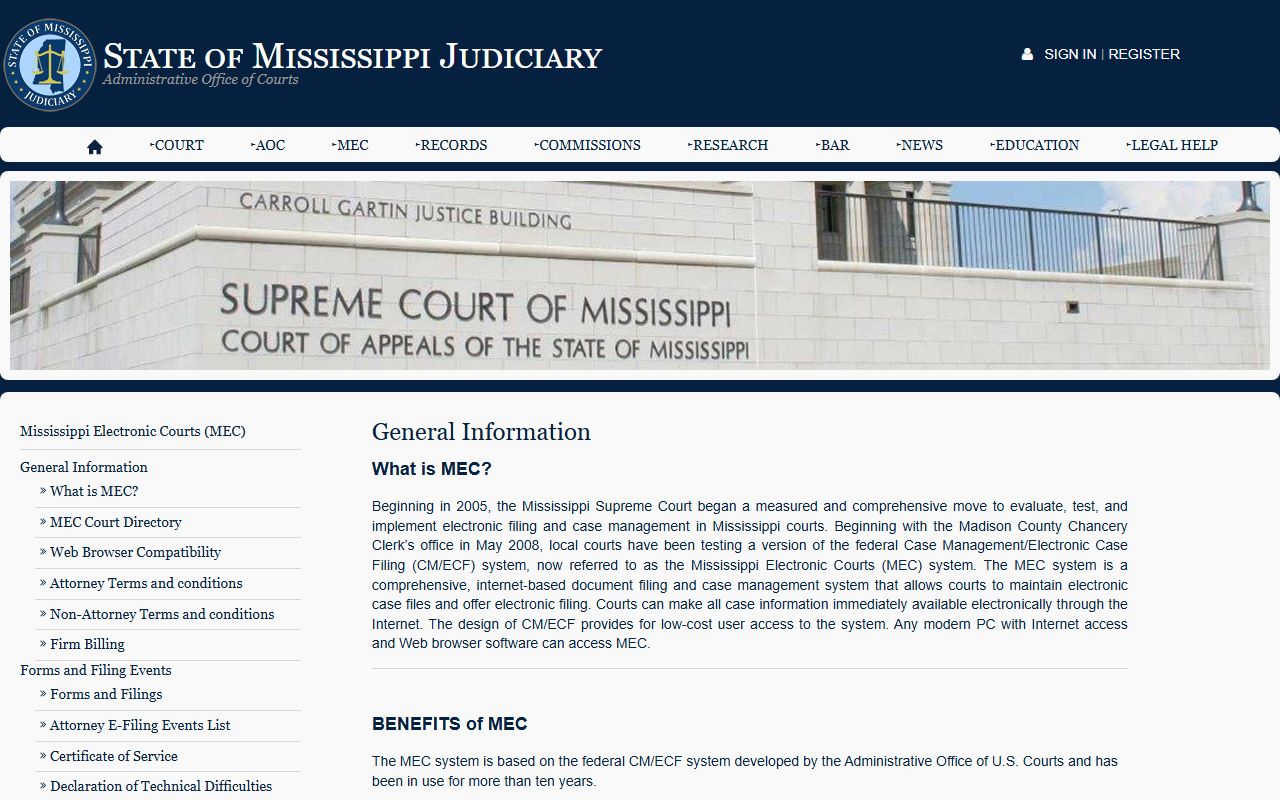
The MEC procedures spell out which case files open to general internet access and which stay restricted. That line between open and limited access is set by court rule, not by the clerk at the counter.
Note: The Public Records Act creates a right to inspect, but court rules, sealed orders, expunctions, and youth-court law can still block release of certain Smith County files.
Records That Are Sealed or Confidential in Smith County
Some Smith County records never reach the public counter. Youth court and juvenile records are confidential under Miss. Code Ann. Section 43-21-251. Sealed records are closed by court order. Expunged records are removed from the public file once a court grants relief. Adoption files, mental-health commitment files, and many domestic matters are also restricted. PAMEC limits remote access to child custody, child support, divorce, termination of parental rights, conservatorship, guardianship, minor settlements, and domestic-abuse protection.
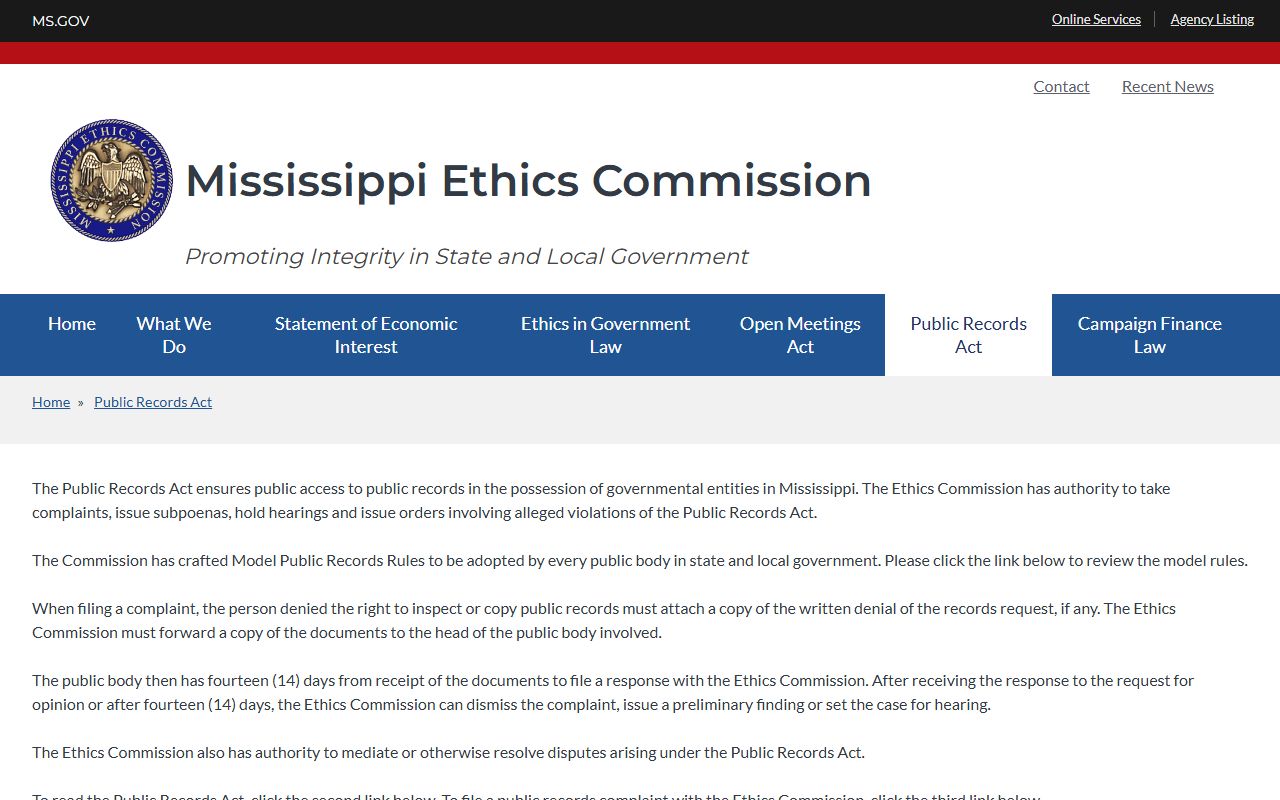
The Ethics Commission resource helps a requester understand which exemptions an office may rely on. It does not override a sealing order or a confidentiality statute.
Expunction is not automatic. A person normally files a petition in the court that holds the record and must meet Miss. Code Ann. Section 99-19-71. A Justice Court misdemeanor goes to the Justice Court Clerk or the court of conviction. A felony goes to the Circuit Clerk, since Circuit Court handles felony cases. After an order is granted, the clerk and the agencies must process the expunction so the public record no longer shows the case. Fees and forms are not posted in county sources, so call the court before filing.
Ways to Request Smith County Court Records
Every channel routes through one of three clerks. Circuit and County Court files go to the Circuit Clerk. Chancery, probate, divorce, and land files go to the Chancery Clerk. Traffic, small civil, and lower criminal charges go to the Justice Court Clerk. Land records are open for inspection at the Chancery Clerk's Office from 8:00 a.m. to 5:00 p.m., Monday through Friday. Other court files should be requested at the matching office by phone, by mail, or in person, and a written public-records request can be filed with the custodian under state law.
Smith County Circuit Clerk
Anthony Grayson, Circuit Clerk
P.O. Box 517
Raleigh, MS 39153
601-782-4751
Fax: 601-782-4007
Circuit and County Court files, jury and marriage-license records
Smith County Chancery Clerk
Cindy Austin, Chancery Clerk
P.O. Box 39, 201 Courthouse Square
Raleigh, MS 39153
601-782-9811
Fax: 601-782-4690
Chancery, probate, divorce, and land records; Mon-Fri 8:00 a.m. to 5:00 p.m.
Smith County Justice Court
Donna Watts, Justice Court Clerk
P.O. Box 171
Raleigh, MS 39153
601-782-4334
Fax: 601-782-5899
Citations, small civil cases, and lower criminal charges
The Circuit Clerk's office and the wider records role are profiled on the Smith County Circuit Clerk page. For mailed Chancery copies, the request must reasonably identify the document and enclose payment and a stamped self-addressed envelope. When no online file exists, a written request to the office that holds the record remains the reliable path.