
How to Search Smith County Court Records
Smith County does not run a single county court search box. Records live with the office that keeps them. The statewide online route is Mississippi Electronic Courts, reached by the public through Public Access Mississippi Electronic Courts, or PAMEC. It is a registered system, not a free open search. Users sign up, pay a small annual fee, and then view documents for a per-page charge. Both Smith County Circuit Court and Smith County Chancery Court appear in the MEC court directory.
Decide which court holds the record before you start. Felonies, indictments, and major civil suits sit with the Circuit Court. Divorce, estates, land, and guardianship sit with the Chancery Court. Traffic tickets, small civil claims, and county misdemeanors outside city limits sit with Justice Court. A name or a case number helps narrow any search.
The county homepage is the quickest map to these offices. The official Smith County website lists the courts, clerks, sheriff, and forms under its Elected Officials and Services menus. From there, the path to each clerk's phone number and duties is short and direct.

That landing page is where most Smith County court records searches begin before a caller is routed to the right clerk.
- Identify the case type. Felony, indictment, major civil, and Circuit docket matters go to the Circuit Clerk. Divorce, probate, estate, guardianship, conservatorship, land, adoption, and custody matters go to the Chancery Clerk. Traffic, small civil, and county misdemeanor charges go to Justice Court.
- Try PAMEC for remote Circuit and Chancery records. Open the Mississippi Electronic Courts public registration site, register if needed, then use the case search after login.
- If PAMEC blocks or excludes the record, call the clerk. The Circuit Clerk handles Circuit and County Court files. The Chancery Clerk handles Chancery, probate, divorce, and land files.
- For land records, visit the Chancery Clerk's Office during posted inspection hours, Monday through Friday, 8:00 a.m. to 5:00 p.m.
- For Justice Court traffic or criminal charges, call the Justice Court Clerk to set a hearing date or confirm a citation.
- For certified copies, ask the clerk for the certification fee and the way to pay it before mailing your request.
The Smith County Judicial System
Mississippi sorts its trial courts by subject, and Smith County follows that pattern. The Circuit Court is the main law court. The Chancery Court is the court of equity. Justice Court is the local entry point for small cases and citations. Above them sit the Mississippi Supreme Court and the Mississippi Court of Appeals, which review trial rulings.
Smith County Circuit Court is part of the 13th Circuit Court District. The county names Matthew Sullivan and Stan Sorey as the district's Circuit judges, each reachable at P.O. Box 545, Raleigh, MS 39153, phone 601-782-4413. Chancery cases are heard by Chancellor David Shoemake, Post 1, in Collins, and Chancellor Gerald Martin, Post 2, in Raleigh. Justice Court judges are David Easterling and Hulon West.
Case flow: Justice Court › Circuit Court › Mississippi Court of Appeals › Mississippi Supreme Court
The county courts page lays out each court and what it hears. The Smith County courts page covers Chancery Court, Circuit Court, the prosecutors, the District Attorney, and Justice Court jurisdiction in one place.
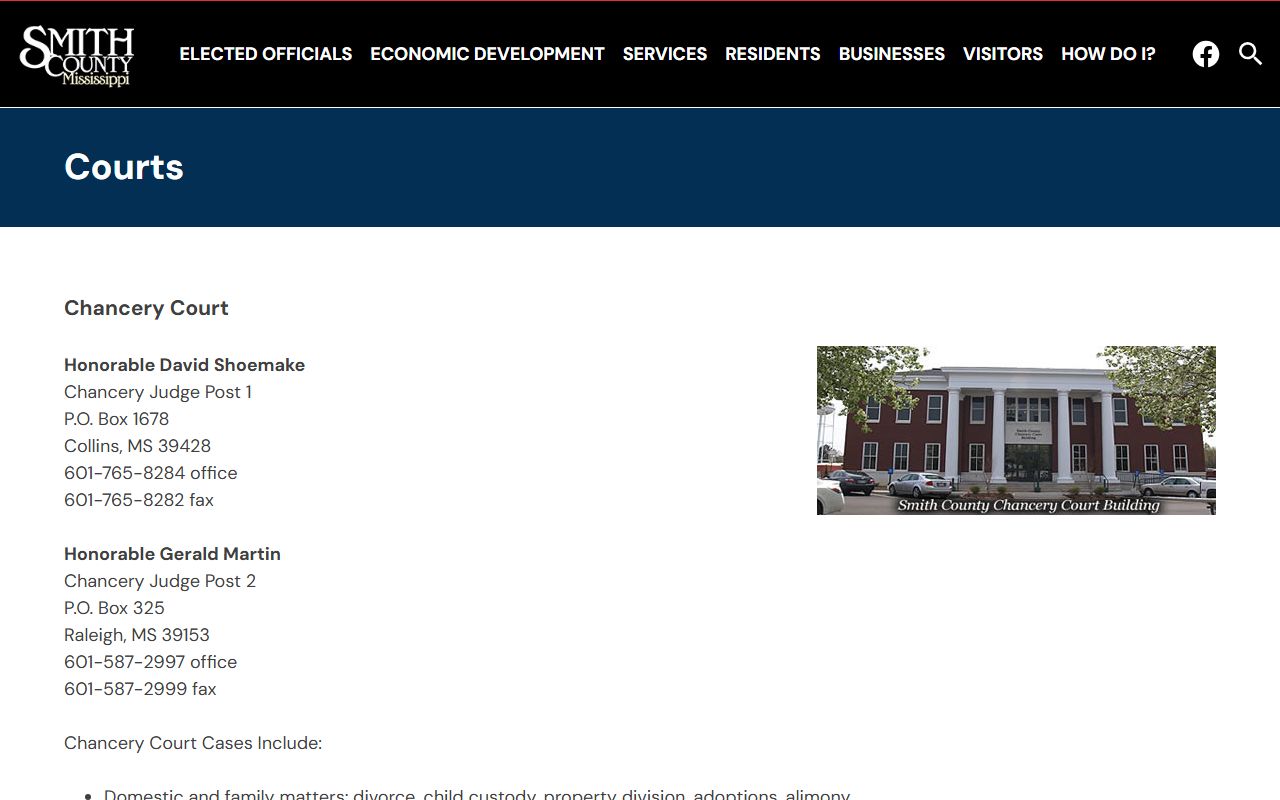
That page is the clearest official summary of how Smith County court records are split among the trial courts.
| Court | Jurisdiction | Case Types |
|---|---|---|
| Supreme Court & Court of Appeals | Appellate | Review of trial court decisions and equity appeals |
| Circuit Court, 13th District | Felony and major civil trial | Felonies, larger civil actions, misdemeanors on appeal, appeals from lower courts |
| Chancery Court | Equity trial | Divorce, custody, estates, land titles, guardianship, conservatorship, commitments |
| Justice Court | Limited trial | Civil claims to $2,500, citations, county misdemeanors outside cities, warrants |
| Municipal Court | City | City ordinance, municipal traffic, and city misdemeanor matters |
Smith County Courthouse and Chancery Building
The court complex sits on Courthouse Square in Raleigh. The Mississippi Department of Archives and History records the Smith County Courthouse as the most prominent landmark in town. It was designed by Weathers-Foley & Company, built in 1912 by Little-Cleckler Construction Company, and named a Mississippi Landmark on June 3, 1996. The building is both an active government center and a protected historic site.
One local detail matters for any visit. The Chancery Clerk records and Chancery Court sessions are now in the new Chancery Building across from the Smith County Courthouse. A person looking for probate, divorce, or land records crosses to that building rather than the old courthouse. The Chancery Clerk page states this move and lists the office duties.
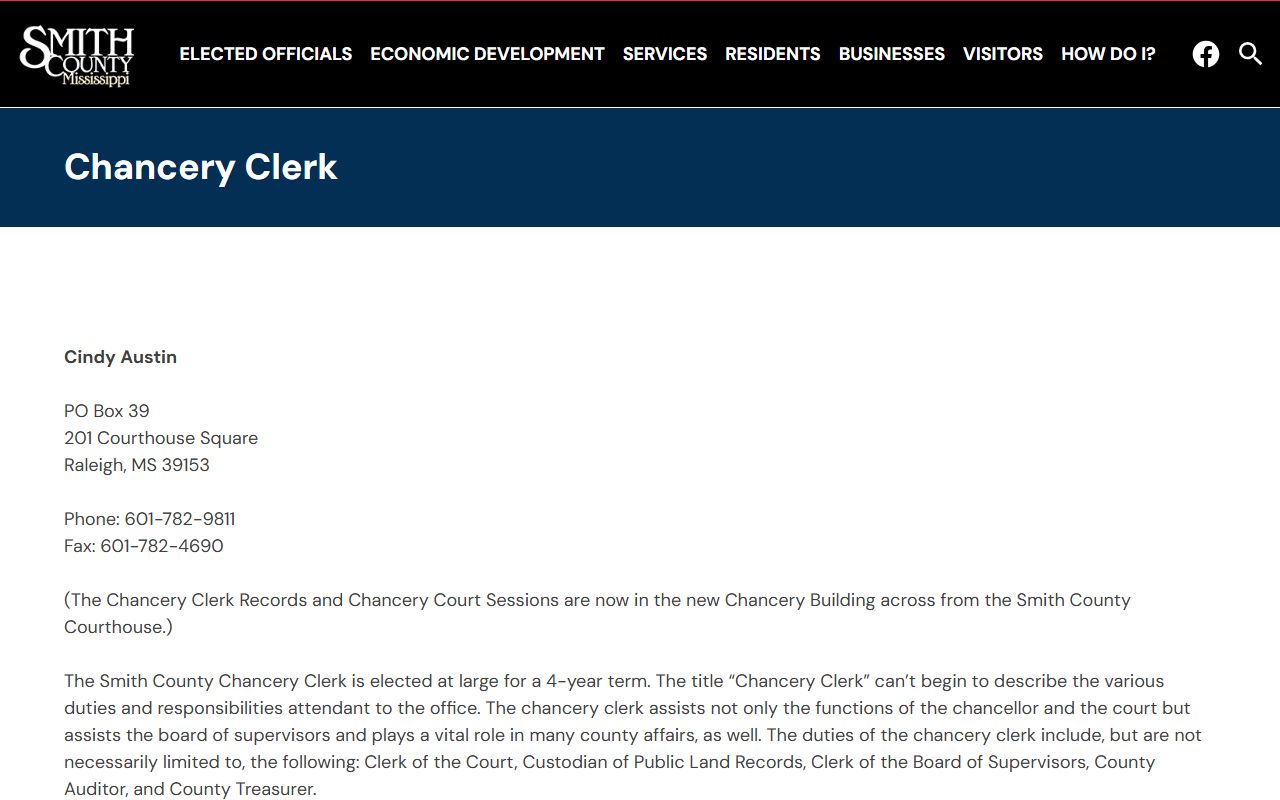
That page confirms where Smith County Chancery court records and land records are kept and how to reach the clerk.
Chancery Clerk / Chancery Building
Cindy Austin, Chancery Clerk
P.O. Box 39, 201 Courthouse Square
Raleigh, MS 39153
601-782-9811
Circuit Clerk
Anthony Grayson, Circuit Clerk
P.O. Box 517
Raleigh, MS 39153
601-782-4751
Sheriff's Office
Sheriff Joel Houston
206 Courthouse Square
Raleigh, MS 39153
601-782-4531
Types of Court Records Available in Smith County
Smith County court records cover every part of county legal life, from felony files to estate papers. The court that hears a case is the court that holds its record. Circuit Court files run through the Circuit Clerk. Chancery Court files run through the Chancery Clerk. Justice Court files stay with the Justice Court Clerk.
The Circuit Clerk keeps a general docket with party names, pleas, indictments, appeal papers from lower courts, orders, the execution docket, and the full record of each suit. The Chancery Clerk keeps suit files, minutes, process, and land records. The Circuit Clerk page lists these docket and jury duties in detail.
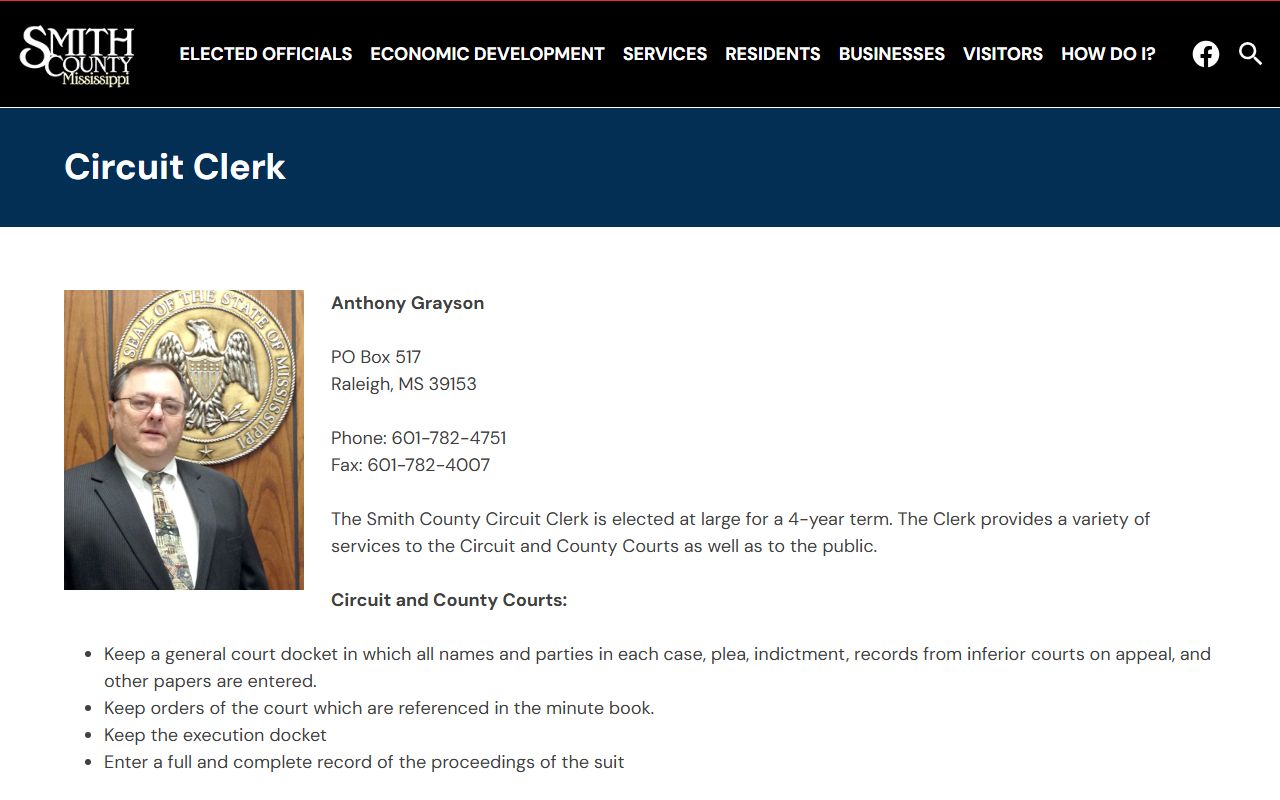
That page shows how Smith County court records for Circuit and County Court matters are docketed and stored.
- Criminal records - felonies, indictments, pleas, and sentences from the Circuit Court, plus county charges from Justice Court.
- Civil records - larger civil suits in Circuit Court and claims up to $2,500 in Justice Court.
- Family and divorce records - divorce, custody, support, alimony, and adoption files in Chancery Court.
- Probate records - estates, wills, guardianships, and conservatorships in Chancery Court.
- Traffic records - citations, fines, and hearings handled by Justice Court.
What Smith County Court Records Show
The fields in a Smith County court record depend on the court and the case type. A Circuit criminal file shows the charge, plea, bond, trial setting, verdict, and sentence. A Chancery file shows the cause number, parties, pleadings, hearings, and the final decree. A Justice Court file shows the citation, charge, court date, fine, and payment status. Public copies leave out Social Security numbers, protected minor names, sealed material, and other shielded data.
| Field | What It Shows |
|---|---|
| Case Number | The court-assigned identifier for the case or cause. |
| Filing Date | When the complaint, petition, or charge opened the case. |
| Parties | Plaintiff and defendant, or petitioner and respondent, plus attorneys. |
| Charges / Cause | The criminal counts or the civil claim behind the suit. |
| Disposition | The current or final outcome, such as guilty, dismissed, or disposed. |
| Sentence / Judgment | The penalty, decree, or money judgment the court ordered. |
Court Types Compared in Smith County
The fastest way to find a record is to know which court should hold it. Each Smith County trial court has its own subject, its own clerk, and its own appeal path. The table below sets the three local trial courts side by side so a searcher can route a request in one read.
| Point | Circuit Court | Chancery Court | Justice Court |
|---|---|---|---|
| Type of law | Law court | Equity court | Lower court |
| Typical cases | Felonies, major civil | Divorce, estates, land | Citations, small civil |
| Juries | Common | Rare, paternity and will contests only | Limited |
| Clerk | Circuit Clerk | Chancery Clerk | Justice Court Clerk |
| Appeals to | Supreme Court | Supreme Court | Circuit or County Court |
Notice that both Circuit and Chancery appeals climb to the state high court, while Justice Court rulings move up to the Circuit or County Court first. The split also tells you which clerk to call before you ever pick up the phone.
Public Access Laws for Smith County Court Records
Record access in Smith County starts with the Mississippi Public Records Act. The law gives any person the right to inspect and copy public records, subject to set exemptions and reasonable procedures. Court rules, sealed orders, expunctions, youth-court law, and privacy redactions can each limit what a clerk may hand over. For remote files, the MEC system carries its own restricted-access rules for sensitive cases.
The county FAQ rollup answers many of the common access questions in plain terms. The Smith County how-do-I page explains land-record access, civil filings, citations, court dates, marriage licenses, and copy fees.
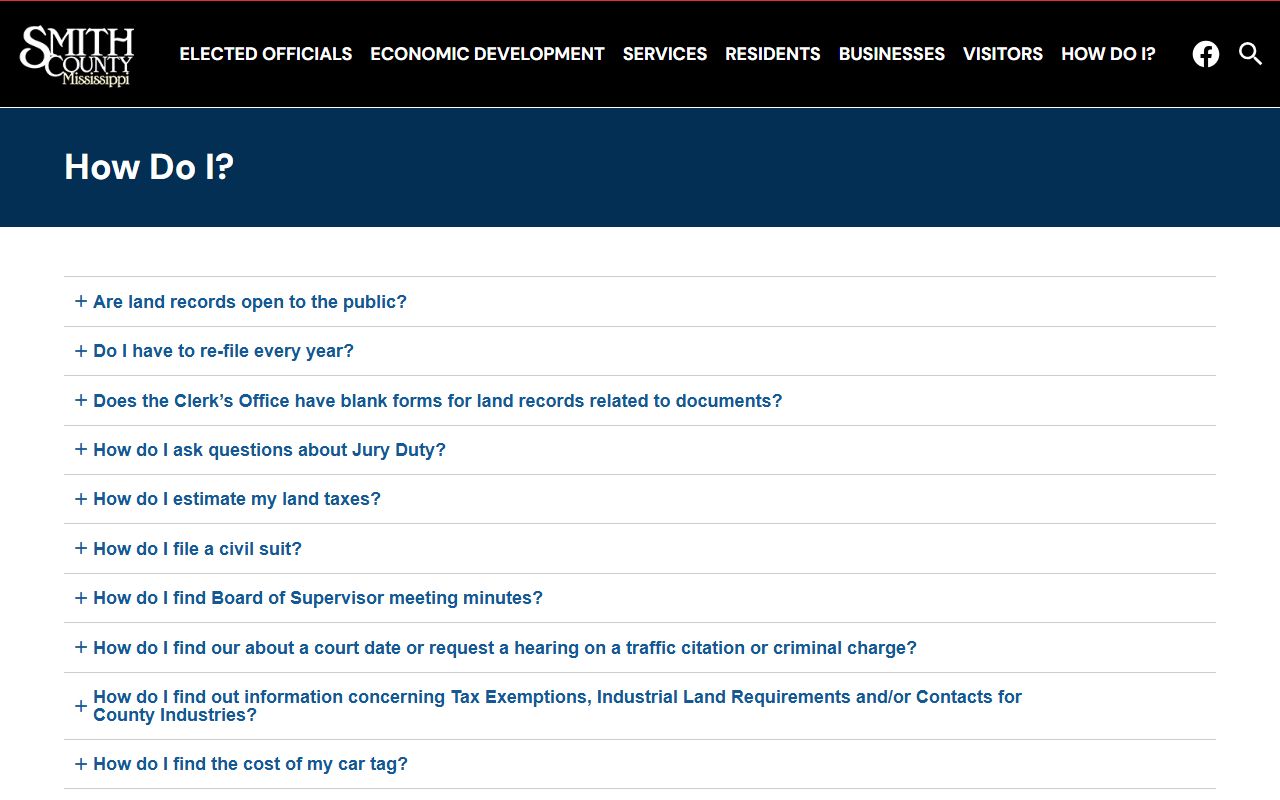
That rollup is a practical companion to the statutes that frame public access to Smith County court records.
Key Statutes:
Miss. Code § 25-61-1 - The Public Records Act says public records stay open for inspection unless another law says otherwise.
MEC Administrative Procedures - Electronic case files are public, but sealed, confidential, and sensitive cases get restricted access.
Miss. Code § 99-19-71 - Eligible arrest and conviction records can be expunged by petition when the statute's terms are met.
Miss. Code § 43-21-251 - Youth court records stay confidential except as youth-court disclosure law allows.
Miss. Code § 91-7-322 - A small-estate successor affidavit can collect qualifying personal property after statutory conditions are met.
Records That Are Restricted or Confidential
Not every Smith County court file is open to the public. Youth court and juvenile records are confidential by statute. Sealed records are closed by court order. Expunged records are removed from public view once a court grants relief. Adoption files, mental-health commitments, and many guardianship or minor-settlement papers are treated as sensitive. The MEC system also blocks remote access to divorce, child custody, child support, and domestic-abuse protection cases.
Expunction is not automatic with age. A person normally files a petition in the court that holds the record and must meet the rules in Section 99-19-71. Check a felony record with the Circuit Clerk and a misdemeanor record with the Justice Court Clerk. After a judge grants the order, the clerk and the agencies involved process it so the public record no longer appears.
Note: Smith County official sources do not post expunction filing fees or forms, so call the court that holds the record before filing anything.
Smith County Court Records Fees
Copy fees in Smith County are set by the clerk and depend on who makes the copy. The Chancery Clerk FAQ posts the per-page rates. A mailed request must reasonably identify the document and include a check or money order plus a stamped, self-addressed envelope. Certified copies cost extra, though the county does not post the certification amount.
The county forms page is a useful stop for related county documents and request materials. The Smith County forms page offers downloadable county forms, including birth-certificate, passport, and voter-registration items.
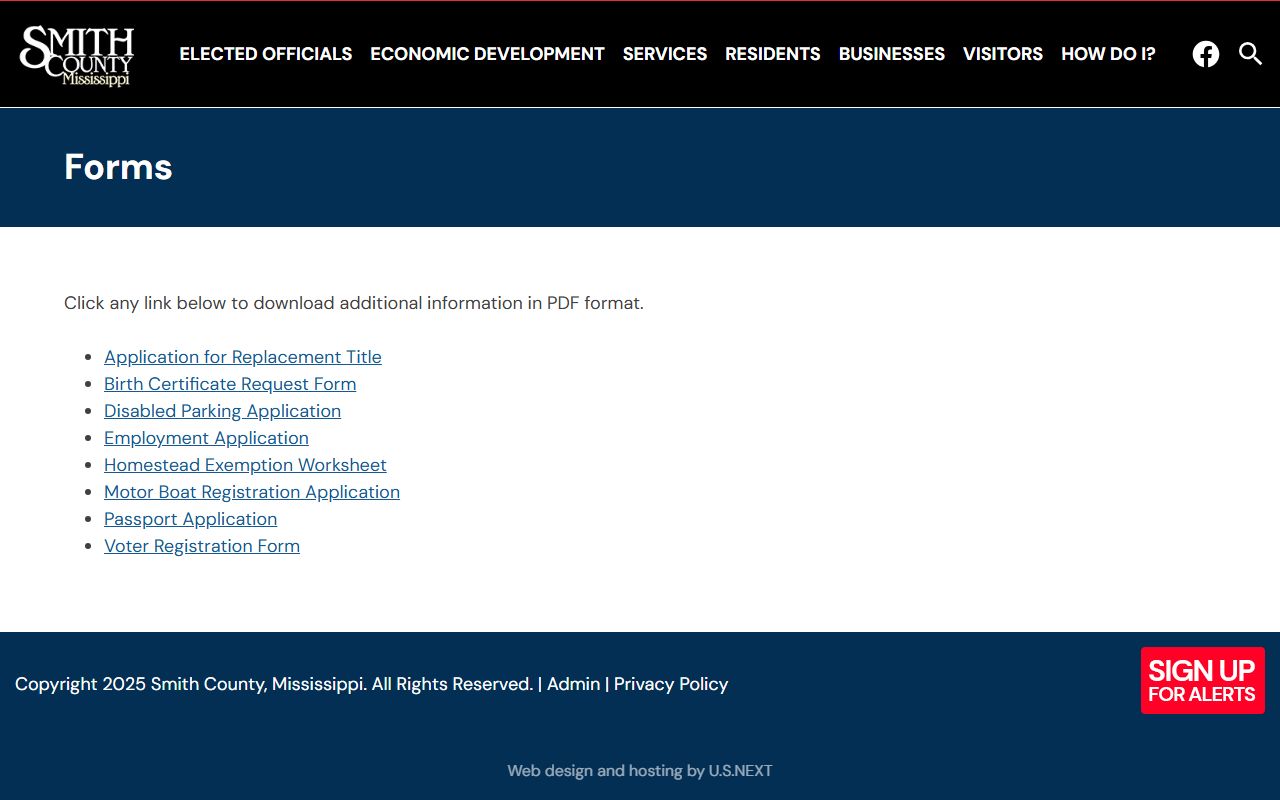
While the forms page is not a court-record portal, it points to the offices that prepare Smith County court records and copies.
| Item | Amount |
|---|---|
| Copy made by the public, per page | $0.25 |
| Copy made by staff, per page | $0.50 |
| Certified copy | Additional fee, amount not posted |
| Marriage license | $21 |
| State marriage certified copy (MSDH) | $17 |
| State divorce index, five-year search (MSDH) | $17 |
Smith County Sheriff and Jail
The Smith County Sheriff's Office is led by Sheriff Joel Houston, sworn in during January 2020 and re-elected in 2023. The office covers about 630 square miles of rural county and runs the Smith County Detention Center, which holds both pre-trial and sentenced adult inmates. Listed services include basic medical care, non-contact visitation, commissary access, and phone use. Visitation is held each Saturday on a rotating schedule, and visitors must bring valid ID.
The sheriff's page links a BlueHorse portal to search current inmates, view booking photos, and see charges. The Sheriff's Office page holds the inmate-search link and the detention-center details.
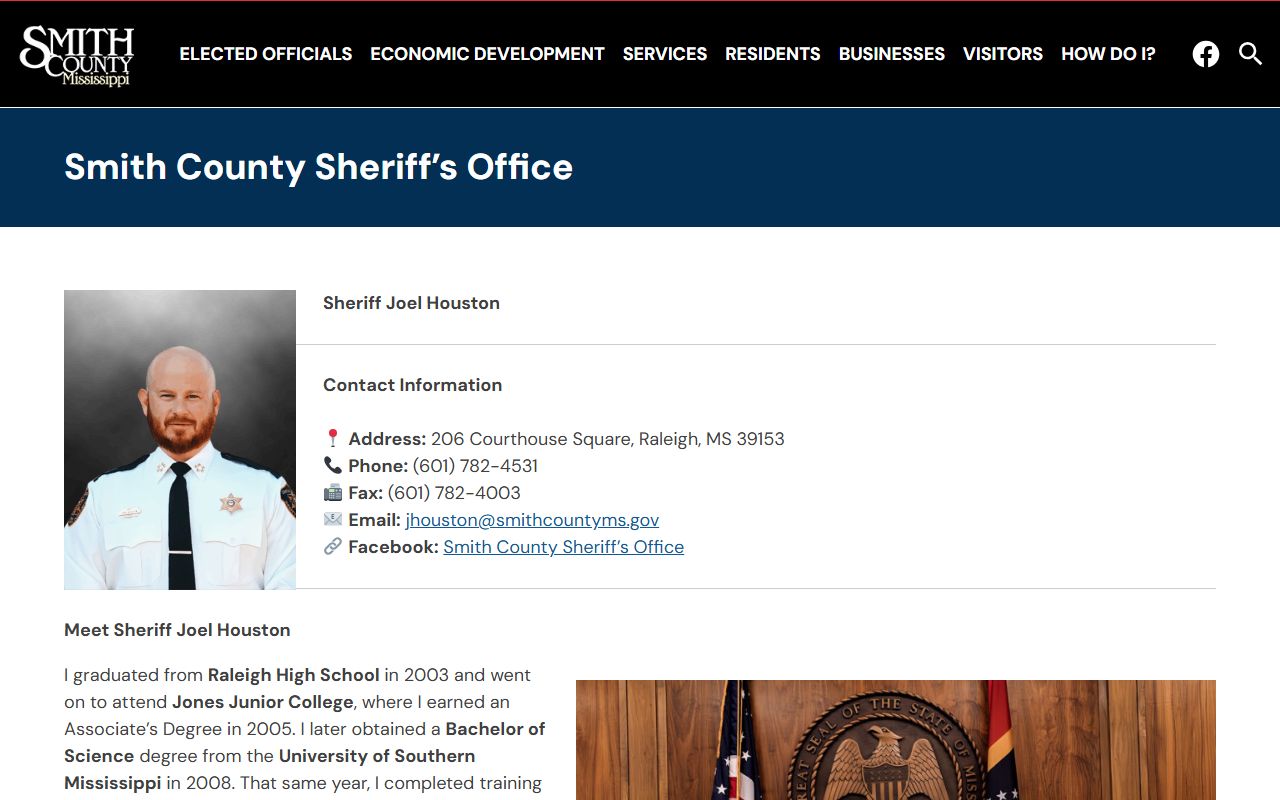
That page is the official gateway to Smith County jail records and current custody information.
For the full roster, booking detail, and how the portal works, see the Smith County inmate records page. For active holds and how to clear them, the warrant records page maps the Justice Court, sheriff, and constable channels.
Marriage, Divorce, and Chancery Court Records
Marriage licenses run through the Circuit Clerk, who collects a $21 filing fee and requires both parties to be 21 or older. Divorce is a Chancery Court matter, so certified divorce decrees come from the Chancery Clerk. The state health department keeps a marriage record and a divorce index, but it does not hold divorce decrees. Estates, wills, and guardianships are also Chancery work.
For the license process, fees, and the state vital-records steps, see the marriage and divorce records page. For estates and guardianships, the Chancery Court page covers filing and copies.
- Testator
- A person who leaves a valid will at death.
- Executor
- The person named in a will to carry out the estate.
- Intestate
- Dying without a valid will, so state law sets the heirs.
- Conservator
- Someone a court appoints to manage an adult's property or affairs.
Searching Court Records Online Through PAMEC
PAMEC is the public window into Mississippi Electronic Courts. It is a registered, fee-based system, not a free county database. A user creates an account, pays an annual registration fee, then pays per page to view documents. Both Smith County Circuit Court and Smith County Chancery Court appear in the MEC directory, so many of their files can be reached from one login. Sealed and restricted cases stay off the public side.
The fields below describe the public registration and login level. The full search screen is only visible after an account is active.
| Field Label | Type | Required | Notes |
|---|---|---|---|
| Account login / registration | Web account | Yes for remote access | Public access requires registration before any document view. |
| Court selection | Dropdown | Yes after login | Smith County Circuit and Chancery courts appear in the directory. |
| Case number | Text | Optional | Standard search path; exact format shows after login. |
| Party name | Text | Optional | Last name or business name; wildcards not verified publicly. |
| Document view | Paid link | Optional | Per-page fee applies; sealed cases are unavailable remotely. |
How to Interpret Smith County Court Records
Court paperwork is full of short terms that change a record's meaning. A charge is not a conviction. A disposition is the outcome, not the filing. A capias is a pickup order, often after a missed court date. Reading a Smith County court record well means knowing the words the clerks and judges use. The list below defines the terms that come up most.
- Disposition
- The current or final outcome of a case or charge, such as dismissed, guilty, or disposed.
- Indictment
- A formal felony charge returned by a grand jury for prosecution in Circuit Court.
- Plea
- A defendant's formal answer to a charge, such as guilty or not guilty.
- Docket
- The running record of filings, hearings, orders, and events in a case.
- Capias
- A writ directing law enforcement to take a person into custody, often after failure to appear.
- Decree
- A Chancery Court's final ruling in a divorce, estate, or other equity case.
History of Smith County Courts
The present Smith County Courthouse dates to 1912 and anchors Courthouse Square in Raleigh. The split between law and equity is older still. The Chancery Court remains a separate court where a chancellor usually hears cases without a jury. Juries appear only in paternity matters and will contests. That tradition explains why probate, divorce, and land cases feel different from a Circuit trial.
Justice Court has its own history. A 1984 Mississippi statute ended the old Justice of the Peace system and set up the modern Justice Court, which now carries the small civil, citation, and misdemeanor work once tied to the justices of the peace. Smith County's court system serves a county of just under 15,000 people across a wide rural area. The Census QuickFacts for Smith County gives the official population and land-area profile.
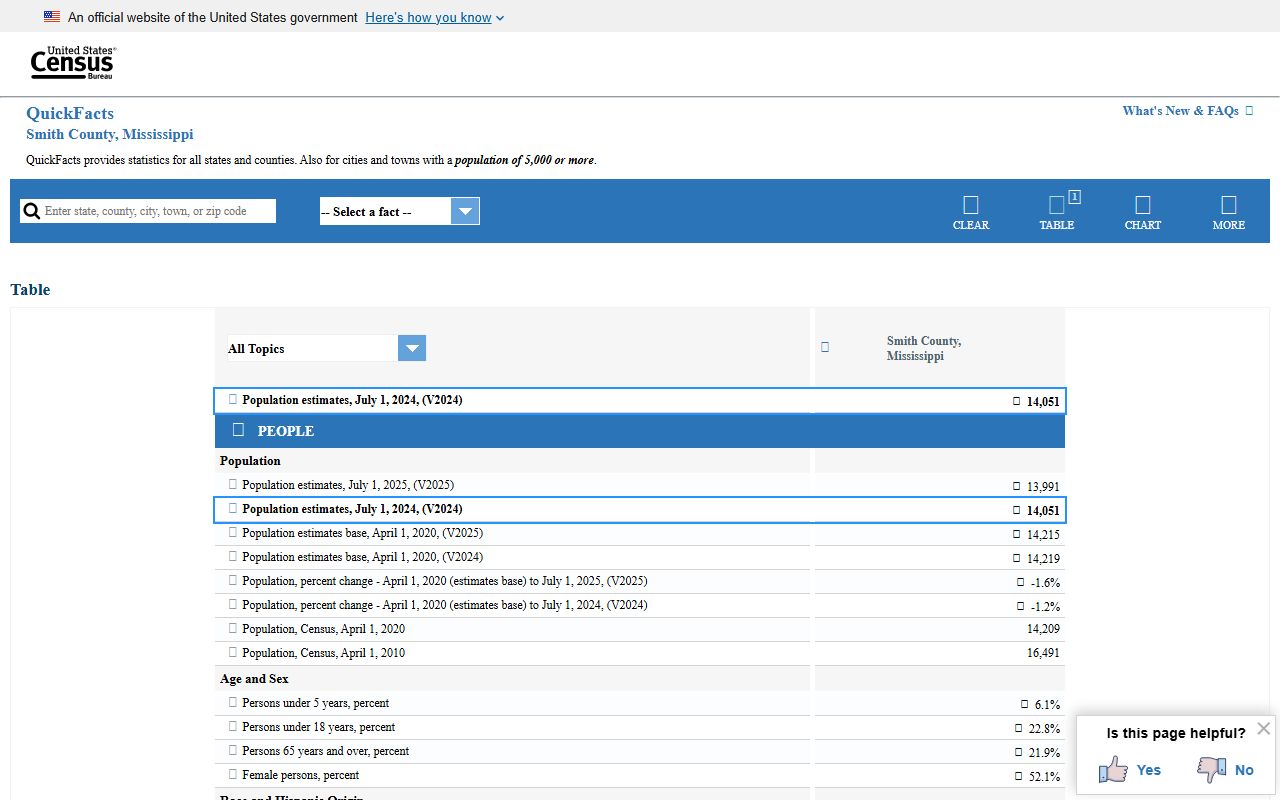
That demographic backdrop frames the volume and reach of Smith County court records across a dispersed population.
Note: Online entries can lag the paper file, so confirm any detail with the clerk who keeps the record before relying on it for a legal or financial decision.
Frequently Asked Questions
Common questions about Smith County court records cluster around where files live and how to reach the right clerk. The court FAQ category answers many of them directly. The Smith County court FAQ category covers the Justice Court clerk, traffic-citation payment, hearings, and jury duty.
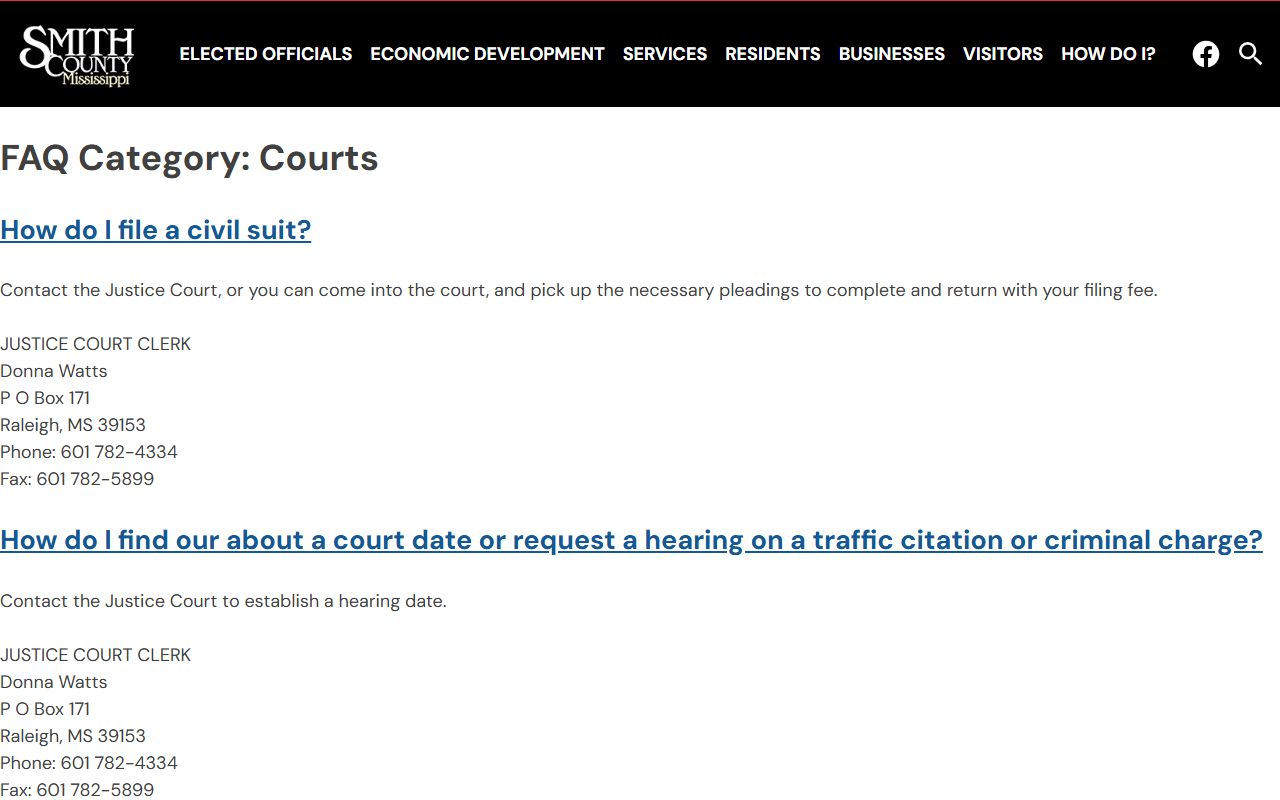
Those answers line up with the most frequent Smith County court records questions below.
Is there a free online search for Smith County court records?
No single free county portal exists. The statewide route is PAMEC, the public side of Mississippi Electronic Courts. It charges a small annual registration fee and a per-page fee for documents. Circuit and Chancery cases appear there when remote access is allowed. When a record is sealed, restricted, or missing online, call the clerk who keeps it instead.
Which court holds my Smith County case?
It depends on the case type. Felonies and major civil suits are Circuit Court matters. Divorce, estates, land, and guardianship are Chancery Court matters. Traffic tickets, small civil claims, and county misdemeanors outside city limits are Justice Court matters. City ordinance and city traffic cases may sit with a municipal court. Matching the case to the court tells you which clerk to call.
How do I get a certified copy of a Smith County record?
Ask the clerk that holds the record. Public copies cost $0.25 per page, and staff copies cost $0.50 per page. Certified copies carry an added fee that the county does not post, so confirm the amount first. A mailed request must describe the document, include a check or money order, and include a stamped, self-addressed envelope.
Where do I pay or contest a Smith County traffic citation?
Justice Court handles traffic citations issued outside city limits. The county tells drivers to contact Justice Court for the amount due and to mail a money order or cashier's check with a copy of the citation. To contest a ticket or set a hearing date, call the Justice Court Clerk, Donna Watts, at 601-782-4334.
How do I find someone in the Smith County jail?
Start with the BlueHorse inmate portal linked from the Sheriff's Office page, which shows current inmates, booking photos, and charges. If the person does not appear or has been sentenced to state prison, the Mississippi Department of Corrections runs a statewide inmate search. For custody or booking questions, call the Sheriff's Office at 601-782-4531.
Where are divorce and probate records kept?
Both are Chancery Court records held by the Chancery Clerk in the Chancery Building across from the courthouse. Certified divorce decrees come from the Chancery Clerk, not the state health department. The state can run a five-year divorce index search for $17 to point you to the county, book, and page, but it does not issue the decree itself.